Case Study

On-Demand Delivery App
Getit
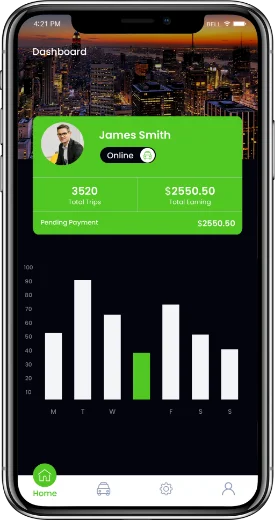
Getit is an on-demand, on-the-go service providing a convenient way for you to get what you need.



About Getit
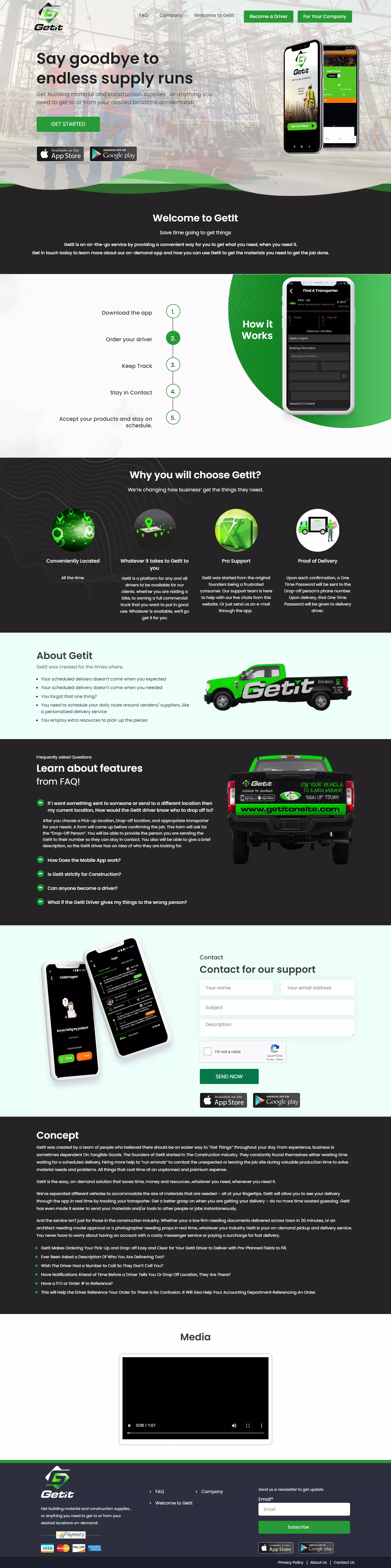
A construction company reached out to us to build an application for an on-demand taxi service. The construction industry faced a lot of challenges with the immediate requirement of materials during the construction process that were not available at hand. We built a customized taxi system with separate applications for customers, vendors, and drivers.


Stakeholders Not Tech Savvy
Problem
The client was clear with their needs but was not tech savvy enough to state specific requirements, making it difficult to translate their vision into concrete deliverables.
Solution
- We initiated brainstorming sessions with the client to plan out the project.
- We discussed challenges of all stakeholders — vendors, drivers etc.
- We helped narrow down their vision to tangible deliverables.
- Based on the requirements, we planned out realistic milestones and a timeline.

Managing All Stakeholders
Problem
In Getit the driver and vendor are treated as separate entities, unlike a regular taxi application where such a division does not exist. This required building separate application flows for each stakeholder type.
Solution
We built application functionality to optimize the process while simultaneously taking all stakeholders into account.

Verifying Driver's Identity
Problem
We had a challenge to digitally verify the driver's identity before registration on the application, as manual checking would take a lot of time.
Solution
- We developed a mechanism to cross-check and perform background verification of the driver's identity.
- Our algorithm used the Social Security Number (SSN) of the driver to check for any sex offender record, criminal history etc.
Separate Location of Vendor's Office & Warehouse
Problem
Most of the time, the registered office location and warehouse location where the vendor stored goods were different, which caused delays — as the warehouse was mostly somewhere in the outskirts of town.
Solution
- The default pickup location of the order was set to the vendor's warehouse.
- An order was only assigned to a driver if he was within a 3-mile radius of the warehouse.


Challenge of Logistics
Maximum Order Delivery in 1-Hour Span
Problem
Delivery is outsourced to taxi drivers at a minimum wage of USD 15/hr.
- Needed a logistics facility only for a limited time to avoid extra cost.
- Delivery persons often repeated routes while on the field, wasting time.
- Mismanagement limited the capacity of orders that could be delivered.
Solution — Zone-based Routing
Divided the deliverable area into four equal zones — A, B, C, D.
Sorted the zip codes as per the divided zones.
Sorted orders in each zone in ascending order of radial distance from the store.
Assigned one delivery person for every zone.
Savings Per Order — Example
Route optimization ensures delivery boys don't repeat routes.
Maximum orders delivered in minimum time.

The Result
We were able to develop a highly functional on-demand taxi service with customizations for the construction industry. We built applications with smooth operation for all three stakeholders — drivers, vendors, and customers (construction company). We solved the issues of distance between construction site and warehouse, payment challenges between three entities, and route optimization for drivers to save freight costs. Thus we were able to help the construction industry move leaps and bounds with their logistics and operations by leveraging technology.